
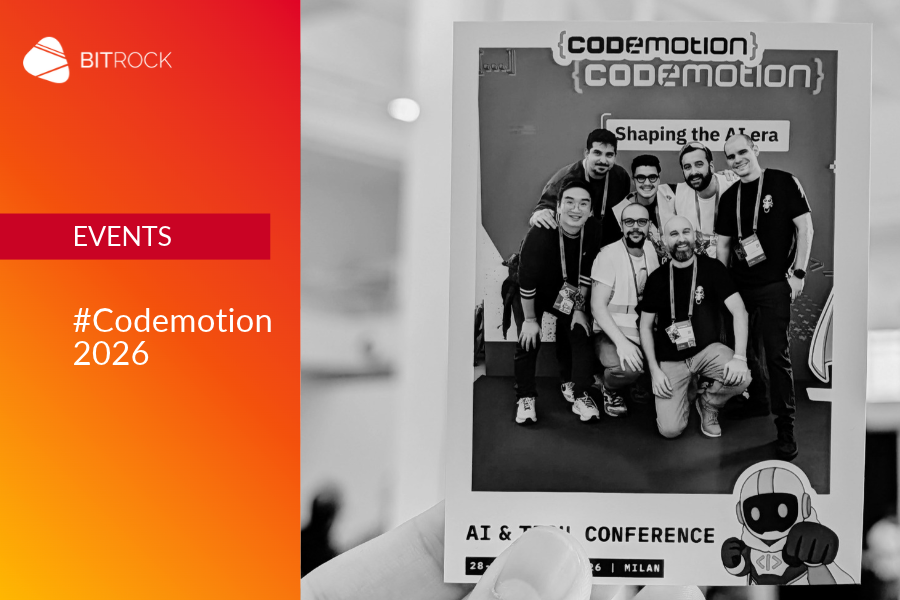
On 28 and 29 October, together with my colleagues Yi Zhang, Andrea Mazza, Federico Vidali, Daniel Zotti, and Mattia Ripamonti, I attended Codemotion Milan 2026 in Milan, one of Italy’s flagship events for software professionals. This year’s claim was clear from the very start: “Shaping the AI era”. Artificial intelligence was everywhere—in the talks, at the booths, and in every conversation by the coffee machine.
What I am taking home, however, is not yet another list of tools or models. It is a candid snapshot of how the Italian tech community is navigating this transformation: what excites it, what worries it, where its strengths lie, and where it still has room to grow.
The Codemotion 2026 Agenda
The Codemotion Milan 2026 programme spanned seven thematic tracks—Artificial Intelligence, Cloud & DevOps, Cybersecurity, Embedded, Emerging Technologies, Leadership & Inspirational, and Software Engineering & Architecture—alongside the Tech Lead Summit, dedicated to CTOs and VPs of Engineering.
Looking through the agenda, it was immediately clear how much the tone had shifted compared to a few years ago: less hype, more awareness and governance. The community is no longer asking whether to use AI, but how to govern it, when to pause, and what value remains firmly in human hands.
This shift was evident across the keynotes: Matteo Flora brought the spotlight back onto AI security, Katharine Jarmul explored privacy and security in AI systems, and Andrey Breslav, creator of Kotlin, posed a question that ran like a thread through many sessions: what is our place in a world where machines write code? Even the titles of the technical sessions reflected the same urgency to put judgement and method back at the centre—from “Why Coding Agents Need You More Than Ever” and Mario Zechner’s “Everything is slop, let’s slow the fk down”, to Matteo Collina’s “Kill the Standup” and “Critica dell’informatica pura” by Gabriele Santomaggio and Paolo Caressa.
It is the very same approach we bring to enterprise projects with our clients at Bitrock every day: AI generates measurable value only when it remains a governed tool, embedded within a shared framework and guided by the critical thinking of the people using it.
“Provocazioni Artificiali”: The Reverse Talk
Among all the sessions I attended, the format that left the strongest impression was “Provocazioni Artificiali”, brought to the stage by our colleague Daniel Zotti, Team Leader & Tech Leader Frontend at Bitrock, alongside Stefano Bruno.
Their starting point was an honest question: in a landscape where almost any technical piece of information is just a prompt away, what value can a traditional talk still offer? Their answer was to turn the format upside down. No code-heavy slides, no pre-packaged demos: the content was built live by the audience through three rules inspired by Fight Club:
- You must talk (the exact opposite of Fight Club, in this case).
- 30 seconds to decide whether to accept the provocation or move on to the next one.
- 5 strict minutes to debate it.
What made the exchange so compelling was not the theses themselves, but the unfiltered reactions. Hearing developers, tech leads, and managers grab the microphone to defend or dismantle a position in real time paints a far more honest picture than any industry survey.
“If AI Does a Junior’s Job, Does It Still Make Sense to Hire Juniors?”
This was the provocation that struck me the most, as it touches a raw nerve across the entire IT sector. Framed this way, it looks like a straightforward cost question: if a Coding Agent can write APIs, tests, and small features in minutes, why invest months in developing someone at the start of their career?
My answer is a resolute yes, for at least three concrete reasons:
- Continuity for tomorrow’s seniors: Tomorrow’s seniors are today’s juniors. A company—and an entire ecosystem—that stops hiring junior profiles is merely postponing the problem by a few years, when there will be a shortage of people capable of governing those very agents.
- Value beyond simple code: A junior’s contribution has never been limited to writing repetitive code. It means learning the business domain, asking the questions an experienced team takes for granted, and bringing fresh tools and habits to the table. Often, it is the youngest engineers who first experiment with a new agentic workflow and pull the rest of the team forward.
- An accelerated growth path: The training path changes, not the need for it. Because AI absorbs part of the execution, juniors can—and must—reach the skills that truly matter sooner: reading and challenging generated code, understanding trade-offs, reasoning about architecture, and building critical thinking. For mentors, the challenge shifts to teaching how to judge, not merely how to produce.
For a company like Bitrock, this is no theoretical debate: developing people is integral to how we work with clients, and AI pushes us to rethink onboarding, not eliminate it.
“The Developer’s Job Is Over”
Another provocation cut straight to the chase, broadening the discussion to the profession as a whole. The developer’s job is not ending; its centre of gravity is shifting. Writing code carries less weight than it used to, while understanding the domain, breaking down complex problems, evaluating architectural trade-offs, and verifying what an agent produces carries far more. It is the practical application of the Human-on-the-loop model: AI executes, while humans steer the process and remain accountable for the outcome.
The Italian Tech Ecosystem
Events like Codemotion also serve to gauge where the Italian technology market is heading, beyond the global trends we read about every day. From conversations on the ground, three clear strengths stand out:
- A lively, critical community: An ecosystem that does not simply absorb tech hype, but challenges it with pragmatism and, at times, a healthy dose of irony.
- Solid engineering culture: Genuine attention to software quality, architecture, and long-term maintainability.
- Closeness to the territory and business: A landscape shaped by companies that need systems to work in real production environments, not just in demos.
At the same time, three areas remain where we still have significant ground to cover:
- Moving from experimentation to production: Proofs of Concept are multiplying, yet cases where agentic AI is stably embedded into core business processes remain relatively few.
- Governance and sovereignty: Organisations need to establish policies, guardrails, and traceability before Shadow AI spreads unchecked on its own.
- Continuous upskilling: Skills age faster than ever, requiring structured learning paths to keep teams up to date without leaving anyone behind.
Having this map is invaluable both as professionals and as a business: it helps us decide where to invest, anticipate the questions clients will bring over the coming months, and contribute by sharing what we learn in the field.
Conclusions
If I had to sum up Codemotion 2026 in a single word, I would choose inspiration. With generative AI, the cost of turning an idea into a working prototype has plummeted: an afternoon—sometimes just an hour—is enough to go from “what if we tried…” to something running. The bottleneck is no longer implementation, but finding the right idea, asking the right question, and identifying a problem worth solving.
That is precisely where events like this make the difference. A talk stumbled upon by chance, a provocation that gets under your skin, or a debate over lunch are the sparks that ignite new solutions, projects, and internal initiatives. Daniel Zotti and Stefano Bruno’s session itself is proof: an idea born out of the desire to do something different became both a live format and an application built from scratch. AI amplifies whatever we bring to it: if we bring curiosity and critical thinking, it multiplies value; if we run on autopilot, it merely multiplies noise.
Codemotion Milan 2026 left me with more questions than answers, which is exactly what I expect from a great event. AI is now a given: the real challenge is governing it, shifting skills from execution to judgement, and continuing to invest in people’s growth and open dialogue.
For us at Bitrock, as we support clients every day in adopting AI within enterprise environments, taking part in moments like these is not an extra—it is part of the job. It keeps us connected to the community, lets us stress-test our ideas, and brings us back to the office with a few fresh provocations of our own.
If you are exploring how to move agentic AI from experimentation into production with the right level of governance and control, let’s set up a session with our architects to discuss your roadmap.
Main Author: Davide Ghiotto, Senior Front-end Developer @ Bitrock