
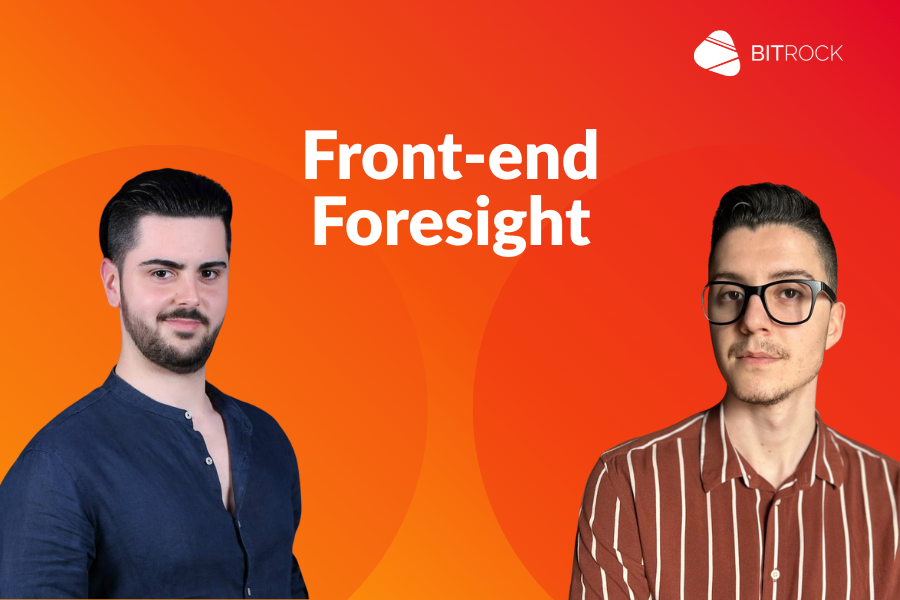
Welcome to Front-end Foresight, Bitrock’s new column, with which we want to take you behind the scenes of our Front-end development team.
Today we will meet Massimiliano Attianese, Junior Front-end Developer, and Davide Ghiotto, Senior Front-end Developer. Through their discussion, we will explore some of the main current and future dynamics of the front-end world: from continuous updating to emerging trends, to the evolution of their role. From their interview, we will also discover how their experience, at different levels of seniority, contributes to defining their daily work at Bitrock.
Let’s get to know our Bitrockers better!
How do you keep up to date with the latest news in the Front-end world?
Massimiliano: I usually follow some blogs, communities on LinkedIn, and I often use GitHub or YouTube repositories.
For me, it is crucial to adopt a practical approach: starting from the official documentation, I acquire the basics of new technologies and concepts. Then, to consolidate what I have learned, I find it very useful to train practically and apply what I have studied theoretically.
However, my preferred way of learning and keeping up to date is through discussion with colleagues. I find that the members of my team are always “on the ball”, and talking to them allows me to discover new perspectives and gain different points of view on a new technology stack or framework, including through practical examples of real projects that I would not otherwise have visibility of.
Davide: My approach is less structured; I would describe it as atypical. After subscribing to several newsletters, I discovered the TLDR technical newsletter, which provides structured reviews of new technologies, approaches, and frameworks. In my opinion, it is one of the best and most comprehensive newsletters available.
I also follow a number of content creators on various platforms, mainly YouTube, who review and give their opinions on various topics and tools. I like to keep up to date with the latest developments, both for myself and to be a point of reference for my more junior colleagues, such as Massimiliano.
Do you consider any trends in the world of Front-end development to be overrated or underrated?
Massimiliano: I think one of the elements that is often overratedis the tendency to acquire and use the latest framework, without evaluating its actual suitability for the context and the existing technology stack. I believe that we should not confuse novelty with the best, and that each project should be evaluated on its own specificity in order to find the most suitable solution.
On the other hand, one factor that I believe is too often underestimated is the basic knowledge: HTML, CSS, pure JavaScript, but also accessibility and performance. I noticed a tendency to immediately want to get your hands on the framework, thinking that it is easier and faster, but I believe that basic knowledge is what allows you to understand the various technologies and apply the new ones correctly.
Davide: I also find that one of the most overrated trends is the attitude towards frameworks, specifically exclusivity. I have often noticed the habit of limiting oneself to just one, but it is important to remember that the framework is an enhancer of our work, not a fixed dogma.
Like Massimiliano, I also believe that studying and understanding the basics are too often underestimated. Throughout my career, I have used various frameworks and, for the most part, I have noticed that their use is facilitated by knowledge of the basic concepts that allow you to fully master new tools.
Which trend do you think will have the greatest impact on the Front-end world over the next five years?
Massimiliano: Obviously, it’s impossible not to mention artificial intelligence. AI is already radically changing our role and will continue to do so in the near future. It’s a tool that we must learn to adoptto improve code writing and better manage many aspects that front-end developers currently have to deal with.
Another significant trend is undoubtedly Web Assembly, which offers incredible solutions and will certainly have a major impact on the future of our field.
Davide: I think AI can be considered a cross-sector trend that will have an impact on the entire world of software development and will involve architectural changesthroughout the industry.
One of the most promising specific trends, as Massimiliano mentioned, is Web Assembly, as well as Micro-Frontend Architecture, where multiple teams with different needs and timelines collaborate on the same application. These architectures are gaining traction because they adapt to the increasing complexity of our role and allow us to create optimised user experiences.
How do you imagine the evolution of your role and what new skills will be crucial?
Massimiliano: Nowadays, front-end developers must have hybridknowledge. They can no longer limit themselves to developing the visual aspect of the application itself, but must have a more general knowledge of architecture, design, user experienceand testing. It is a matter of combining different skills to create a better and more efficient application. We must not overlook the soft skills that are fundamental, especially the ability to teamwork and collaborate with all project stakeholders, which are indispensable skills, particularly in a consulting environment such as Bitrock.
Davide: With the acceleration of processes enabled by AI, the very specific and repetitive tasks of writing code for individual pages or features will be a thing of the past. The work will move away from low-level implementationand it will be necessary to develop holistic reasoning skills. By accelerating development, AI will allow front-end developers to do more and overcome the barrier between front-end, back-end and design. It will become essential to develop interpersonal skills with colleagues and clients, beyond strictly technical and operational skills.
How would you describe your ideal colleague?
Massimiliano: I think the ideal colleague is, first of all, passionate, with a desire to share their knowledge and skills. As I am still a junior figure, it is essential for me to have colleagues who are open to exchange and non-judgmental, so I feel free to ask questions and seek clarification and feedback in order to continue learning and growing.
Davide: It depends on the point of view. At an operational level, to maximise productivity, the ideal work colleague is someone with similar skills and expertise to mine, someone I can talk to as an equal and whom I trust, especially when it regards critical thinking. I really enjoy working with open-minded people who give feedback and help me understand when I am doing something wrong or right, so I can trust their opinion.
From another point of view, the pleasure of working, the most important element is passion. When a person is passionate, whatever the task to be performed or the bug to be fixed, it becomes a pleasure to discover and broaden one’s horizons. In this case, I prefer a more passionate person, regardless of seniority.
We would like to thank Davide and Massimiliano for accompanying us on this short journey to discover some aspects of the Front-end world.
As has become clear, this field is constantly and rapidly evolving, which is why at Bitrock we constantly invest in continuous training and in creating a stimulating environment, where discussion, curiosity and the strategic adoption of new technologies are the order of the day.
We believe that the true strength of a team lies not only in technical ability, but also in the ability to communicate and work together to transform complexity into high-performance solutions for our customers.
To learn more about our services and our approach, contact our experts.