
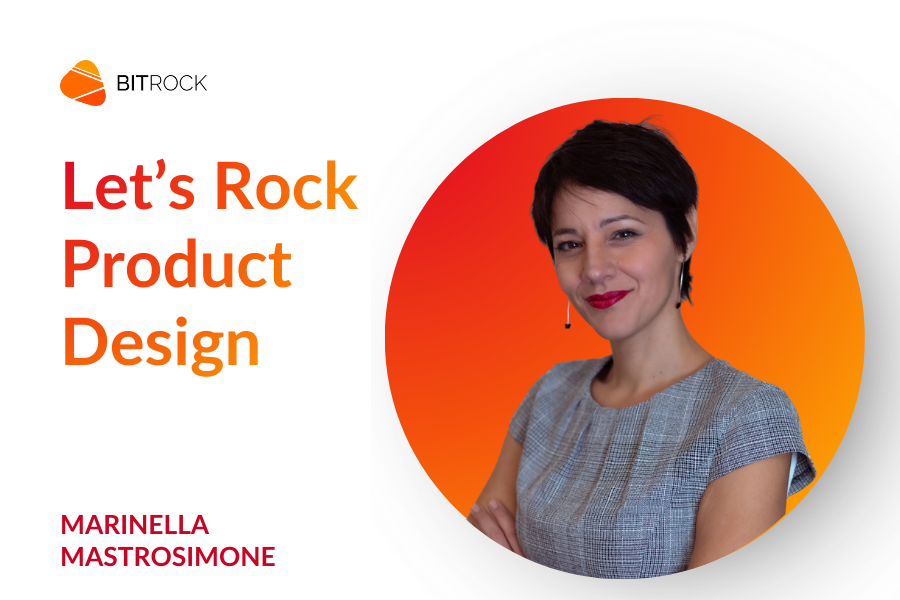
In today’s technology market, which is saturated with standardized solutions and advanced automation, the role of design is undergoing a profound metamorphosis. It is no longer just a matter of mapping user paths or choosing color palettes; it is a matter of taking a holistic view of the product.
In this interview, Marinella Mastrosimone, Senior UX/UI Designer, offers her perspective on the profession.
From the need for ethical and inclusive design to the challenge of governing Artificial Intelligence without becoming dependent on it, Marinella proposes her concept of the contemporary designer: a professional who has the curiosity to explore new patterns of interaction, the responsibility to place humans at the center of every technical decision, and the ability to meet business expectations.
How do you keep up to date with the latest news in the UX & UI world?
I have always kept up to date by periodically analyzing the latest trends and technical innovations, consulting portals such as UX Awards and Awwwards and other sources to identify the most valid solutions. However, I am noticing a change: while in recent years the trends were mainly stylistic, there is now increasing talk of user experiences linked to new ecosystems. Interaction is no longer limited to a mobile phone screen: today it is fragmented between smartwatches, VR, voice interfaces, and interaction between different digital and analog solutions.
Our daily lives are already immersed in augmented reality—think of the possibility of projecting a piece of furniture into our room before buying it or running the Tour de France from home with rollers and sensors to measure how efficient our heart is. These are UX trends that are becoming normalised.
To ensure a solid approach, in addition to following the Nielsen Norman Group guidelines, I supplement my training through the Interaction Design Foundation. I follow specialisation programmes taught by global leaders such as John Maeda (VP of Design and Artificial Intelligence at Microsoft) and William Hudson (pioneer and mentor of UX research), keeping myself constantly updated and certified. I also enrich my method through active discussion, ensuring that solutions are always in line with the latest innovations in the sector.
Finally, I strongly believe in discussion: in addition to activities within the Design Bitrock team, I try to participate in communities such as Frank Spiller’s “Inner Circle” or workshops held by Vitaly Friedman. Interacting with external figures is vital in order not to remain closed in one’s own bubble.
Do you consider any trends in the world of UX & UI Designer to be overrated or underrated?
interfaces, but tools that are embedded in a flow of real interactions between people. Digital technology is merely a point of contact in a customer experience that exists in the physical world. Failure to acknowledge this connection results in the design of technically perfect solutions that lack context and real human value.
Rather than the concept of Minimum Viable Product (MVP), I look at Minimum Lovable Product (MLP). With the same investment, the difference lies in the attention to detail, such as small, agile features and design insights that simplify the user’s life and build loyalty. This approach does not neglect business objectives, but enhances them through a multidisciplinary synergy that coordinates technique and vision from day one, ensuring a solid, harmonious, and distinctive product.
An illuminating historical example is the construction of the Milan Metro by Albini, Helg, and Noorda. In that project, architecture and graphics were developed simultaneously, shaping each other to deliver a user experience so consistent that it won the Compasso d’Oro award in 1964 (it seems impossible that it’s so old, right?). Underestimating aesthetics and attention to detail in favor of pure functional process is, in my opinion, a strategic mistake: design can restore value and character to products. The goal is not only to respond to standard patterns to ensure ROI, but to concretely improve people’s lives through the care and functionality of the product.
How do you imagine the evolution of your role and what new skills will be crucial?
I believe that the role of the designer will increasingly be to combine digital experience with the real world. But there is one fundamental point I want to emphasize: the most important skill will be ethics.
We must be aware that our choices have an impact on society. If we ignore the fact that text that is too small excludes the elderly or disabled, we are committing a civil liability error. Don Norman often talks about this: the priority skill is recognizing the social role of the designer.
Regarding AI, the key skill will be the courage to experiment and make mistakes. AI should be used extensively; we need to “get our hands dirty” to understand where it fails and learn how to train it. Only by experiencing the tool’s errors firsthand can we maximize our potential and help users and customers avoid them. We must be like researchers who test solutions on themselves before returning them to the world. We must not fear AI, but learn to know its strengths and weaknesses, understand it, and educate it before it becomes the only (often limiting) way to interact with modern tools.
How would you describe your ideal colleague?
First and foremost, I value a sense of humor. It may seem trivial, but in a team that has to solve complex problems, being witty and knowing how to lighten the mood is essential.
I look for knowledgeable and curious travel companions. Healthy collaboration is based on fundamental trust: everyone must feel free to say “I was wrong” without fearing that someone else will use this admission to take advantage.
My ideal colleague, regardless of age, has a Socratic approach: they accept dialogue as equals and are as loyal as I try to be. A junior colleague can bring me patterns and worldviews that I, after twenty years of experience, may no longer see. The value of an idea does not depend on years of career experience, but on the ability to solve the problem.
What is the biggest change in the industry since you started working?
Undoubtedly, the transition from a technology–driven approach to a structured user–centric one. Historically, companies were driven by technology: the customer requested, the technicians executed, and the output was ‘probable’. Users were not considered, and the effectiveness of the solutions was often unknown.
Due to the implementation of Agile methodologies and an enhanced understanding of business requirements, a shift in perspective has occurred. It has been recognised that investments in research yield returns in the form of customer satisfaction and ROI. We no longer solely create products that address customer demand; instead, we develop solutions that anticipate and address the needs of our users while aligning with business objectives.
Finally, I embrace Planet-Centric Design: we are no longer just at the center of a digital ecosystem, but of a planet that requires sustainable and circular design choices.
Conclusion
At Bitrock, our IT consulting company, we don’t just provide technical solutions; we promote conscious digital transformation, where design helps clients clarify priorities, reduce decision-making risk, and achieve measurable results, starting from a real understanding of people and operating with an ethical and inclusive approach and high quality standards.
We firmly believe that the future of technology lies not only in the hands of algorithms, but in the ability of experienced professionals to guide them with human sensitivity and strategic vision.
If you would like to design the future of your product with a user-centric and holistic approach, find out more about our Product Design & UX Engineering team.