
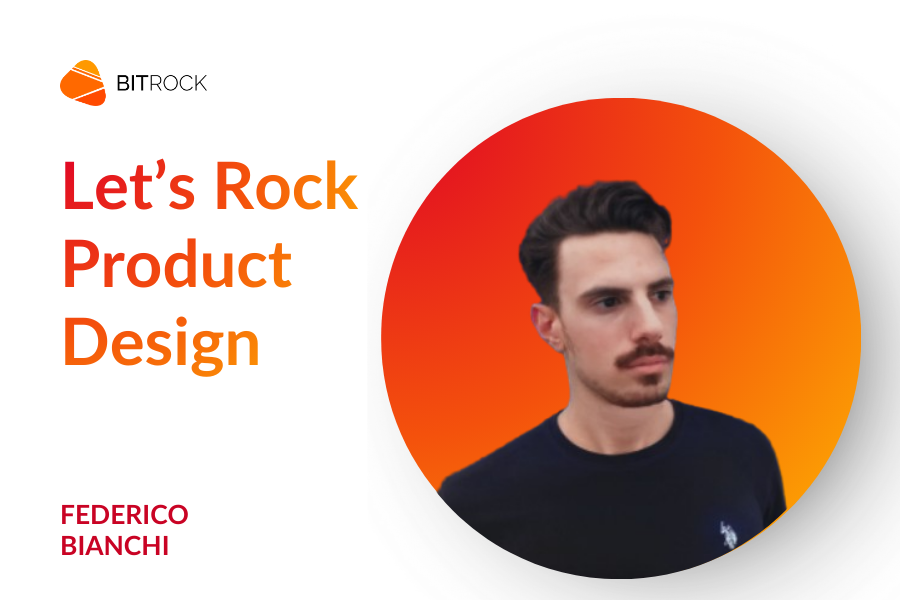
In the current technological environment, innovation is no longer assessed only in terms of computing power or coding, but rather in the ability of a digital product to seamlessly integrate into the user’s life. For a leading IT consulting company such as Bitrock, an end-to-end approach cannot be separated from excellent User Experience design.
Design is the bridge between technical complexity and business value.
In today’s rapidly evolving landscape, it is essential to understand the role of a designer. To address this question, we conducted an interview with Federico Bianchi, a Junior UX Designer at Bitrock. During our conversation, he provided valuable insights into emerging trends, the significance of microcopy, and the transformative impact of Design Systems. Through his perspective, the company’s commitment to nurturing talent that not only focuses on aesthetics but also emphasizes strategy and usability becomes evident.
How do you keep up to date with the latest news in the UX & UI world?
It is crucial to establish a clear distinction between the two areas, as they progress at different speeds. UX (User Experience) is founded on human mental models characterized by slow and non-linear evolution, which is why the discipline rarely sees completely new innovations. My work often consists of rediscovering or reiterating fundamental principles, such as those defined by the Nielsen Norman Group. I subscribe to newsletters and information channels that discuss classic topics, which may be overlooked in the fast pace of daily development, but which remain highly relevant. My role involves constantly reviewing methodological techniques.
However, I believe that these principles should not be applied rigidly. For a UX designer, it is essential to strike a continuous balance between methodological assumptions and practical requirements. Despite the existence of best practices and international standards, practical challenges such as technical constraints, budgetary limitations, and time constraints often make full compliance difficult in daily operations. This is where true expertise lies: in the ability to strike a balance between theoretical perfection and practical necessities, ensuring an optimal user experience while maintaining the efficiency of the production process.
The UI (User Interface) is linked to the world of graphics and aesthetic trends, where changes occur rapidly. I use Behance and Dribbble for visual inspiration, and Awwwards for advanced interactions. However, it is important to approach these resources with a critical eye, as many online solutions are overly generic for real contexts. The key is to strike a balance between creativity and practicality, ensuring that interfaces remain relevant and functional over time. My update is designed to address this challenge, by aligning with current trends while maintaining a foundation in usability principles that stand the test of time.
Do you consider any trends in the world of UX & UI Designer to be overrated or underrated?
The Glass Effect (Glassmorphism) is a design trend that has been popularized by Apple’s recent aesthetic choices. This translucent style has been a subject of debate in the design community. Some critics argue that its application at the operating system level can compromise readability and accessibility due to the unpredictability of the background chosen by the user.
However, I believe it is underrated when used in controlled contexts. In a specific business application, where we have full control over the color range, button hierarchy, and font, the Glass Effect can be managed ad hoc to create an elegant and functional interface. Furthermore, with the advent of augmented and spatial reality headsets, this style will likely become the industry standard. It is essential to acclimate the user’s eye to these transparencies, as opaque black blocks obstructing the view are not feasible in AR glasses. This evolution in visual habits is a subject of criticism today but will soon become the norm.
How do you imagine the evolution of your role and what new skills will be crucial?
Artificial Intelligence is a major current topic of interest.
It is a common misconception that AI will replace designers. While it is indeed already possible to generate simple interfaces with just a few prompts, the reality is somewhat different. AI excels at performing tasks based on clear instructions, but struggles when the problem is not clearly defined. Customers often require digital transformation, but do not themselves know what the main problem to be solved is. This is where the human factor remains irreplaceable.
I see my role evolving to encompass the responsibilities of a behavioral analyst and psychologist. In a future dominated by adaptive interfaces, designers will no longer design individual buttons, but will establish the rules of behavior for the system. The crucial skills will be empathy, data analysis, and accessibility. We must ensure that every innovation, whether vocal, gestural, or visual, is usable by everyone.
In this evolution, microcopy (or UX writing) will play a pivotal role. We are not merely referring to ‘writing texts’, but rather designing those concise groups of words — form labels, error messages, menu items, calls to action — that guide the user step by step. Microcopy is an essential tool that streamlines navigation, provides user reassurance during uncertain interactions, and transforms impersonal interactions into personalized experiences.
While AI can facilitate layout generation, designers must develop specific skills to address friction points and eliminate the subtle ambiguities that can hinder navigation. Caring for microtexts means understanding that each word influences conversions and accessibility. Consequently, design will increasingly become a matter of strategy and conversation, rather than merely “coloring” pixels. Our task will be to provide technology with a voice and a clear direction.
How would you describe your ideal colleague?
Design is not a solitary act; it is an iterative process of continuous validation.
The ideal colleague is what I would term ‘Feedback Friendly’. The ability to give honest and constructive feedback without belittling the other person, but with the sole aim of improving the final product, is essential. In a growth phase, having a discussion with a senior profile is vital as it allows you to pick up on details that had previously escaped your notice.
I would also highlight curiosity as a key attribute. Working in technology demands continuous learning and growth. The ideal colleague is someone who shares relevant information, whether it’s news, a new tool, or a case study they have recently read. The capacity to collaborate effectively, present your work, and embrace diverse perspectives is what elevates a good project to an exceptional one.
What is the biggest change in the industry since you started working?
There’s been a radical shift from “page-based” design to “component-based” design through Design Systems. When I started, the approach was centered on individual screens, as that’s how it was taught. However, when working on real, complex projects, it becomes clear that this method is not scalable.
In the current landscape, there is a shift towards component design. When you need to create a feature, you don’t design the page, but rather check which components of the Design System you can reuse or which new elements you need to create so that they are optimized and maintainable over time. It’s a continuous challenge, because tools like Figma constantly introduce new variables and automation logic that require you to update and optimize components created just a year earlier. The design process has evolved into a fluid one, bringing it into closer alignment with software architecture than was previously the case.
Conclusion
Federico’s experience illustrates that contemporary design is now a core component of successful IT projects, not just an accessory. At Bitrock, a leading IT consulting firm that specializes in helping companies with their innovation projects, we understand that digital transformation requires a balance between engineering and strategic design.
From the creation of scalable Design Systems to the meticulous curation of Microcopy and accessibility, our UX team works to ensure that every technology solution not only performs well, but also generates real value for the end user. By choosing Bitrock, you will be collaborating with professionals who, like Federico, look beyond current trends to build robust, inclusive digital systems that are ready for tomorrow’s challenges.
Would you like to optimise the user experience of your digital products or create a Design System specifically tailored to your company? Request a consultation with Bitrock’s experts today